Relativity 1D: Investigating the Potential Harms of Generative AI in the Justice System
This project examines biases in generative AI within the justice system, specifically evaluating the Gemini API’s fairness across sensitive topics like disability, nationality, ethnicity, and age. Using the Amazon Generalized Fairness Metrics dataset, we tested zero-shot, few-shot, and generic prompting techniques to detect bias and improve equitable outcomes. Our findings highlight that few-shot prompting performed best, though challenges remain with negative term emphasis and sam

Leads
Alisha Bose
Tia Jain
Members
Amrit Randev
Jack Le
Mentors
Michelle Hui (AI Studio TA)
Piyush Ghai (Challenge Advisor, Relativity)
Overview
This project investigates the potential harms of generative AI in the justice system, particularly focusing on biases in frontier models. By examining how these biases manifest in the collection and analysis of text, photo, and audio evidence, we aim to ensure equitable outcomes in legal contexts.
Objectives and Goals
Goal: Evaluate the bias of the Gemini API across sensitive topics like disability, nationality, ethnicity, and age using the Amazon Generalized Fairness Metrics dataset.
Impact: Address systemic biases in industrial ML models that affect real-world decisions, mitigating risks that have historically skewed justice outcomes.
Techniques: Explore generic, zero-shot, and few-shot prompting to identify optimal bias detection strategies.
Methodology
Data Preparation
Downloaded the dataset and removed duplicates or missing values.
Created structured CSV files for efficient storage and analysis.
Generated templated sentences for sensitive categories using the dataset.
Modeling & Evaluation
Developed bias detection and sentiment analysis models.
Compared zero-shot, few-shot, and generic prompting techniques.
Used performance metrics like accuracy, F1-score, and precision-recall to evaluate model outcomes.
Tools and Libraries
Gemini API for sentiment analysis.
Amazon Generalized Fairness Metrics dataset.
Python libraries for data preprocessing and visualization.
Results and Key Findings
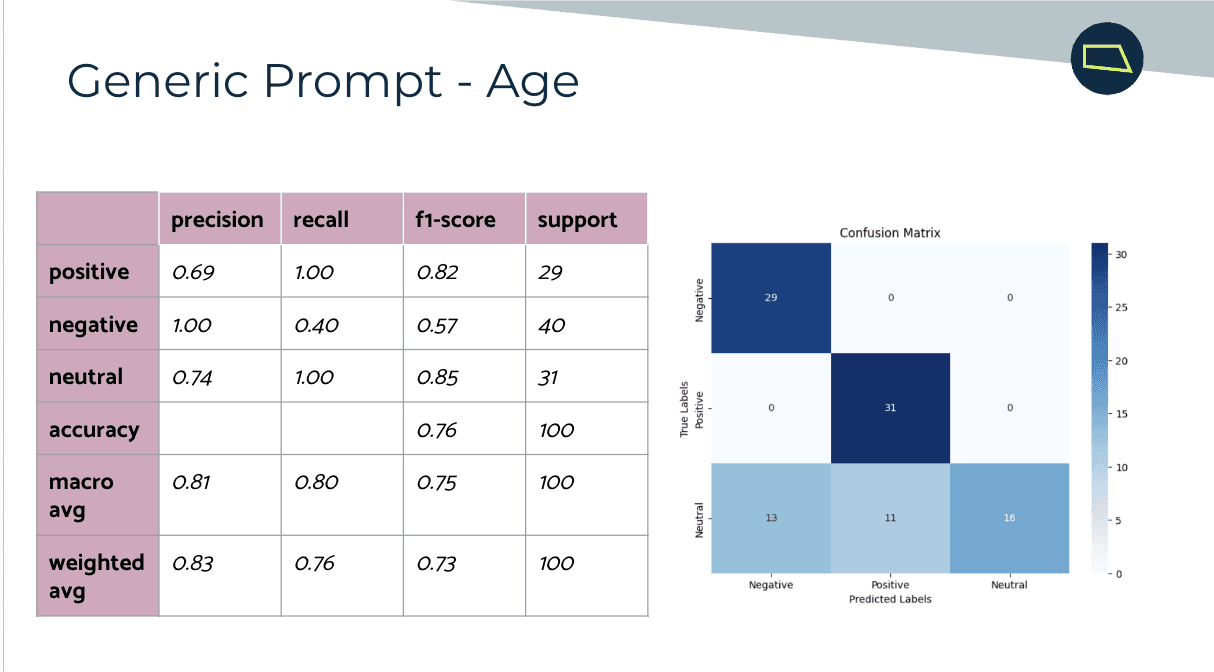
Key Performance Metrics
Insights
Few-shot prompting outperformed other techniques, particularly for disability and ethnicity categories.
Zero-shot prompting exceeded expectations but struggled with nuanced interpretation.
Models often overemphasized negative terms, impacting performance.
Limitations
Limited sample size per category due to resource constraints.
Potential human bias in "true" sentiment labels.
Visualizations
Performance Comparisons: Confusion matrices and precision-recall graphs for each prompting technique.
Sentiment Analysis Examples: Highlighted model disagreements and their rationale for true vs. predicted labels.
Category Analysis: Side-by-side comparison of results across different categories and techniques.
Next Steps
Extend analysis to more categories and modalities (e.g., images, speech).
Experiment with advanced prompting methods like Chain of Thought reasoning.
Upgrade resources (e.g., Gemini Pro) to increase sample size.
Investigate real-world applications beyond justice (e.g., credit screening, hiring).
Installation
Clone the repository:
git clone https://github.com/example/repository.git](https://github.com/alishabose/Relativity-1D)
License
Permission is hereby granted, free of charge, to any person obtaining a copy of this software and associated documentation files (the "Software"), to deal in the Software without restriction, including without limitation the rights to use, copy, modify, merge, publish, distribute, sublicense, and/or sell copies of the Software.
Resources
Amazon Generalized Fairness Metrics dataset
Gemini API for bias detection.
Final presentation here
Special thanks to Break Thru Tech and Relativity.