
ConnectCrew: A Student Volunteering App
A designed solution for connecting college students to volunteering organizations.
Role
UI/UX Designer
Industry
Community
Duration
6 months

Problem Statement
How might we support and connect students who want volunteer hours to civic organizations who need volunteers in the most efficient way?
Stage 1: Research
Mary’s Place: A non-profit based in Seattle, with a focus on women and homelessness, that has an online application for volunteers.
Volunteero: A UK-based app that centralizes volunteering for organizations and volunteers.
VolunteerMatch: An online website that helps connect volunteers to potential volunteering opportunities.
User Quotes from Preliminary Interviews
“...[opportunities are] scattered around the internet in different websites in different specific organizations... gather all of this information and sort them together then it will be easier for people that are not familiar with technology and the internet to find better opportunities that are fit for them.” From a student at UW (YW)
“I think it can be hard to [volunteer] as a college student just because of our like ever changing schedules of like, never knowing exactly what we're going to do in a day.” From a student at UW (AD)
“ ...generally, the only massive challenge is to figure out a way to understand how many volunteers we would need, because we don't really know how many people will actually show up.” From a volunteer organization employee (AB)
Personas and Journey Mapping


Research Key Findings
Centralizing Opportunities: Difficulty looking for opportunities/volunteers because of how disconnected and scattered the searching process is
Word of Mouth: Most students/organizations are finding opportunities/volunteers through their peers, but it is not an efficient or reliable process
Busy Schedules: Difficult for college students to find time in their busy schedules to volunteer in comparison to high school
Our Design Requirements
We came up with design requirements for our final prototype. From here, we continued onto storyboarding, information architecture, low-fidelity, and concept testing.


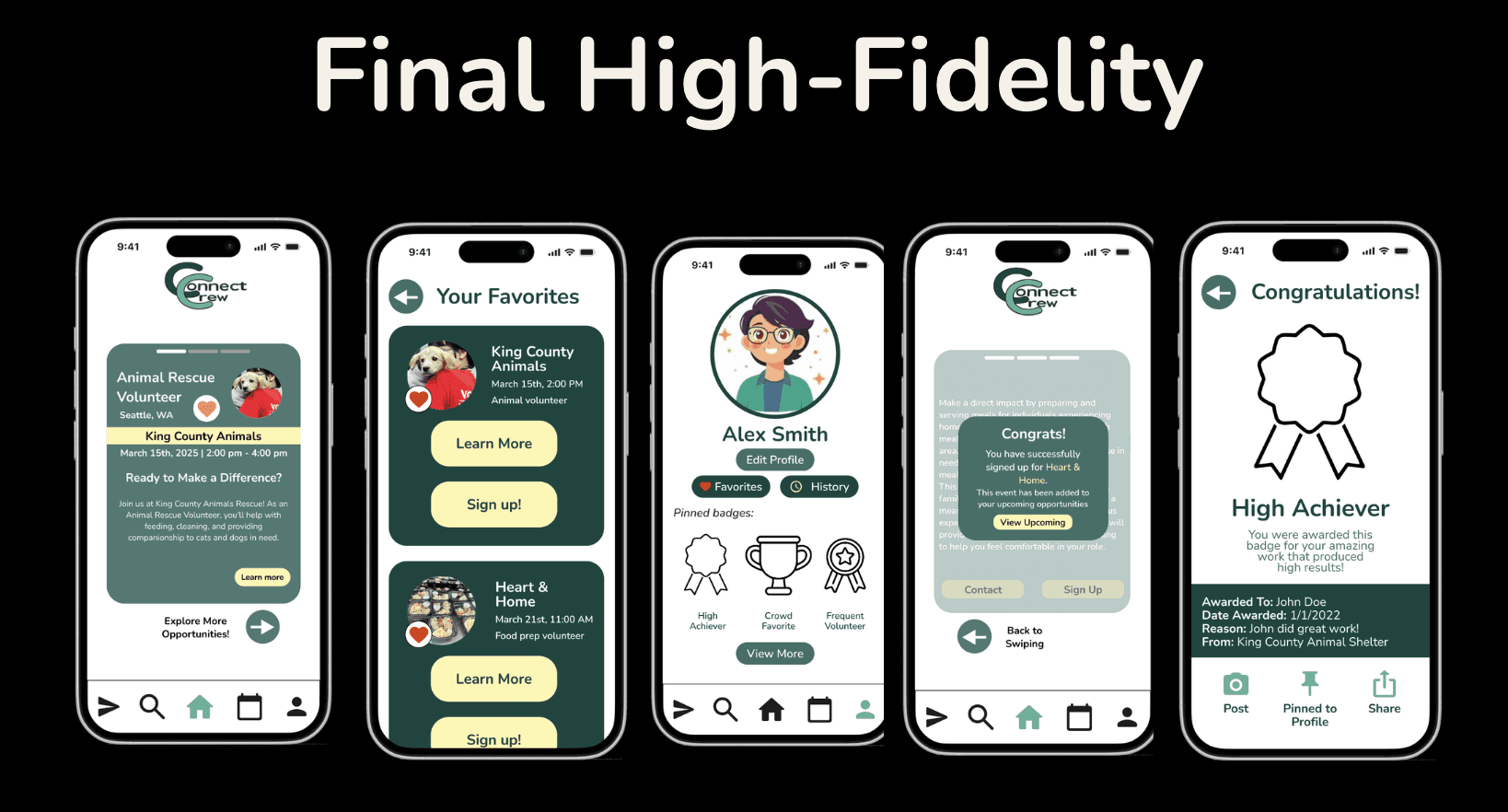
Conclusion
Our final, high-fidelity prototype satisfied our design requirements and passed concept testing. Take a look at our final presentation and our demo video above, or here.